
The Windowcard in Westport
Reg Rogers Is Hilariously Idiosyncratic as Napoleon in 'Pride and Prejudice, Part 2'
David Buchanan
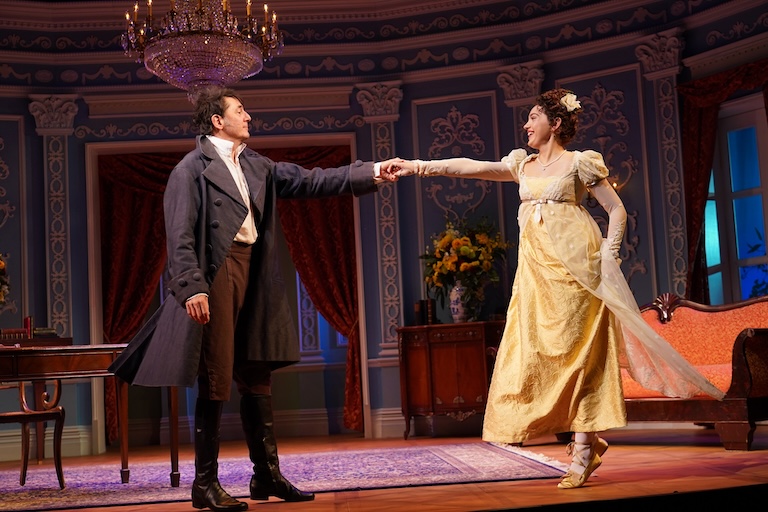
When the eponymous character in Ken Ludwig’s newest play Pride and Prejudice, Part 2: Napoleon at Pemberley first appears on stage at the regional Westport Country Playhouse, the disgraced, displaced former emperor does not arrive with a flourish. No, as portrayed by the singularly entertaining Reg Rogers, Napoleon slinks along sideways, looking upstage, before turning to face his unlikely hosts, Mr. Fitzwilliam Darcy and Mrs. Elizabeth Darcy, now one year married, as well as the audience as he assesses Pemberley, his short-term English hideaway en route to his exile in Elba.
It is an unexpected (and smart) entrance for Rogers as Napoleon, in a play that repeatedly undermines our expectations of how the tyrannical military leader would conduct himself if planted in the cherished novel of manners. Indeed, in his opening scenes, Napoleon is at turns despondent and bellicose, at first chiding heroine Elizabeth (a winsome Delphi Borich) for continuing to refer to him as an emperor—the play takes place during his first abdication—then, moments later, barking commands from the windows of Beowulf Boritt’s handsomely-appointed set; Borritt also designed the rich forced-perspective scenery for Broadway’s The Imaginary Invalid, which is playing concurrently with Napoleon at Pemberley.
If this character sounds like the Bonaparte one would expect following his military defeat and impending exile, Ludwig’s character perks up precipitously as a gaggle of characters, both Austen’s and not, fill the stage. In these earliest scenes, the animosity between Napoleon, disguising himself as a Rothschild, and Lady Catherine de Bourgh from Austen’s novel, played by Kristine Nielsen, sparkle the most.
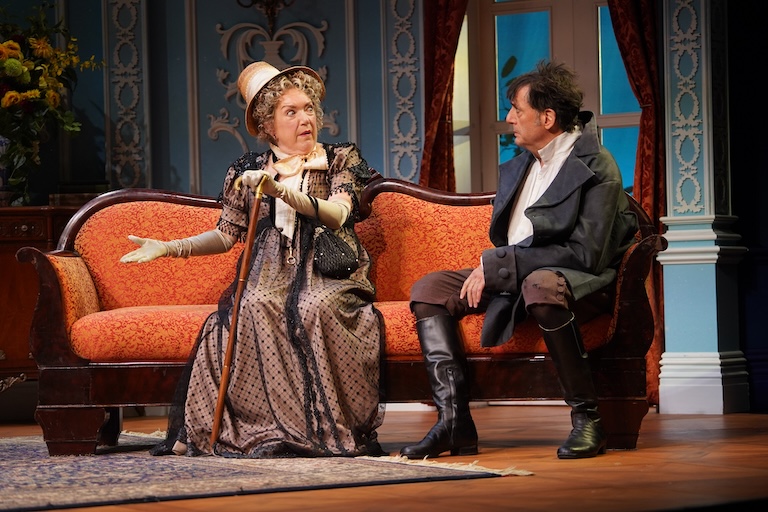
One of the gifts of this production is the novel opportunity to watch these two reliably smart Broadway talents in especially close proximity. Even though their New York stage appearances are prolific, Rogers’ and Nielsen’s most recent outings in Merrily We Roll Along and Smash: The Musical, respectively, were staged in the Hudson Theatre with 970 seats and the Imperial Theatre with 1,443 seats.
Though a tad underserved in such a large ensemble, Nielsen inhabits a feistier but no less class-conscious version of Christine Baranski’s character Agnes van Rhijn on The Gilded Age, on which Nielsen co-stars as the van Rjihn house cook. Her Lady Catherine wields her cane more as a means to bludgeon others than as a walking aid for herself. A scene in which the ever-immodest woman pretends to be so adept at speaking French as to have a conversation with Napoleon stands out amongst her best, as does her smarting facial expressions when she gets thwarted by her daughter by Napoleon at Pemberley’s end.
Surprisingly, Ludwig doesn’t keep the entirety of the play focused on a querulous Napoleon scheming his means of escape and future military domination. That potential version of the play would have indubitably been a more prim and perhaps more spiritually akin to Austen’s novel, and a historical curio for a thematically serious dramatist. But Ludwig, that precision humorist behind Lend Me a Tenor, instead finds ample laughs and pathos in Napoleon’s (historically accurate) romanticism.
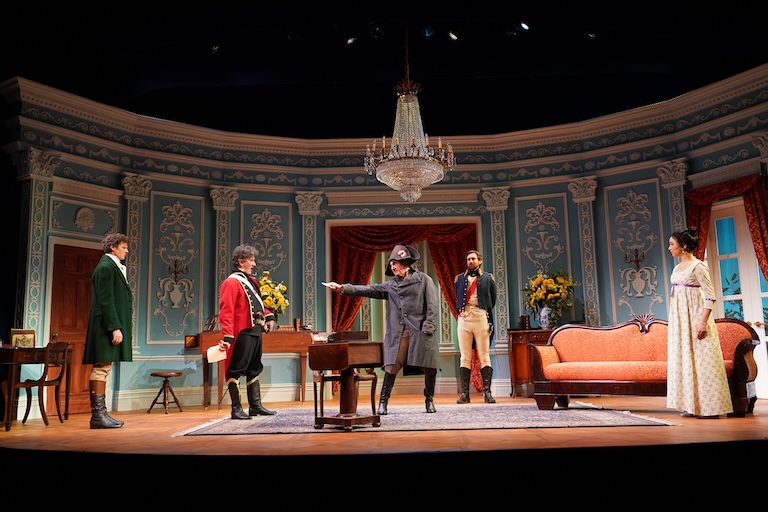
The plot centers entirely on Napoleon’s sojourn in Pemberley, but the machinery truly begins to hum when Lydia Wickham (Lucy Austin), Elizabeth’s sister, suggests that the recent Mrs. Darcy host a ball at Pemberley; Bonaparte thus spends his stage time equally torn between using the event as a diversion to escape his sentence in Elba and his sheer delight at planning and attending a sizeable gala. In one of his funniest moments, Tony Roach’s Mr. Darcy squabbles with Napoleon, who has thrown himself into the minutia of the affair, about the true colors of the house linens. Are they true gray or blue-hued, Napoleon inquires, while hilariously enrobed in them.
Rogers’ best scene—and perhaps Ludwig’s best written scene in Napoleon at Pemberley—has nary any humor in it, save Rogers’ idiosyncratic and always delightfully off-kilter accenting and punctuation of words. Alone with Elizabeth, the two characters discuss literature and politics, including a woman’s role in England’s parliamentary government. After offering a positively flattering assessment of his accomplishments on behalf of Western civilization, Napoleon bemoans that half the world is sitting on their hands, and he implores the young Elizabeth to do something profound, accentuating that there is not much time for any of us. It is a suggestion she adopts with vigor, especially at the ends of the first and second acts.
Lest fans of Ludwig’s farces fear that Pride and Prejudice, Part 2 comes across more tender than Tenor—I won’t soon forget the late Jan Maxwell’s fiery bedroom tirade opposite Anthony LaPaglia in the 2010 revival, for example—Napoleon at Pemberley boasts no shortage of comedic diversions, including a sword fight, errant gun shots, manically-played piano, and secret romps. While the ongoing Austen craze likely ensures an extremely healthy life for the play regionally, this world premiere production boasts an irreplacable delight: Mr. Rogers as Napoleon himself.
Follow The Windowcard on Facebook, Twitter, Bluesky, and Instagram for more in-depth articles and interviews.