

Long-form theatre journalism and opinion covering Broadway, the Tony Awards, and beyond.
Nota bene: This article contains detailed descriptions of scenes from Girl, Interrupted, including the production’s final moments.
In an early scene of Girl, Interrupted, a world premiere play with music at The Public Theater, Susanna Kaysen describes her first night at McLean psychiatric hospital as the equivalent of embarking on “a perilous journey from which she can never return.” Indeed, the off-Broadway play by Pulitzer Prize winner Martyna Majok with score by esteemed songwriter Aimee Mann amply fulfills this promise of an emotionally harrowing — and theatrically enriching — experience.
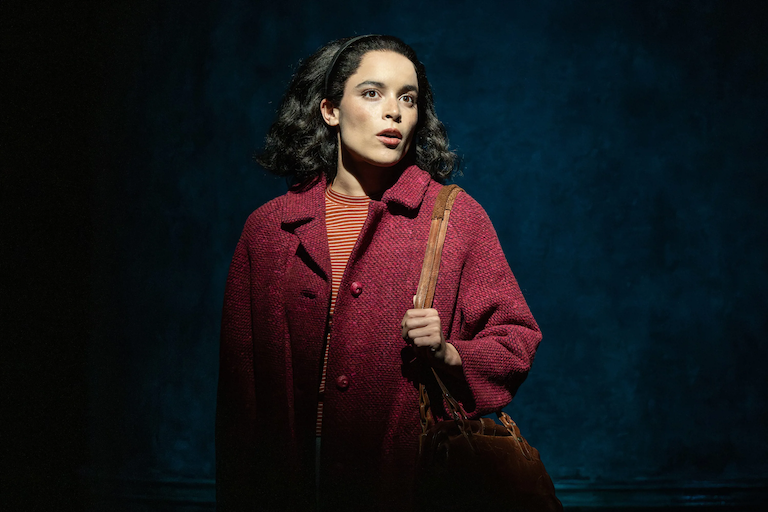
I cannot fathom a better performer to embody Kaysen and shepherd the audience through such rich, tumultuous material than Juliana Canfield.
Most recently seen on a New York stage in Stereophonic, an epic marathon of a drama that holds the record for the most Tony Award nominations for a play, Canfield knows from navigating the “play with music” genre, especially ones that require emotional intensity and significant character transformation across time. Two years on from Stereophonic’s opening, I can still recall with vivid clarity the look of devastation and resentment on Canfield’s face as her character, Holly, decides to leave her bandmate boyfriend Reg, played by Will Brill; both earned Tony nominations, and Brill received the award.
Though Girl, Interrupted does not boast the hefty runtime of Stereophonic, it requires no less, if not more, from Canfield, as she must inhabit Kaysen at three distinct ages and moments in her life. Playwright Majok tasks the character with frequently stepping in and out of the frame of her time at McLean, enacting and then commenting on scenes that occurred twenty years apart, often in immediate succession. It is an extremely effective conceit, especially because of the material’s origins as a memoir, but a high-wire act to stage without feeling dissonant or didactic. Canfield navigates these myriad transitions seamlessly.
We first meet Susanna through her recollection of seeing the Johannes Vermeer painting “Girl Interrupted at Her Music,” from which the title of Kaysen’s memoir, James Mangold’s Academy Award-winning film, and now Majok and Mann’s play derive. Canfield’s vocal work in this scene carefully establishes the dichotomy to come: she uses a smart, cool intonation, almost aloof — as perhaps a cultural anthropologist might sound — but with a trace of whimsy or even mischievousness, such as when she tells the audience, “People used to ask me How’d I end up in a mental institution. But what they really want to know is Could they.”
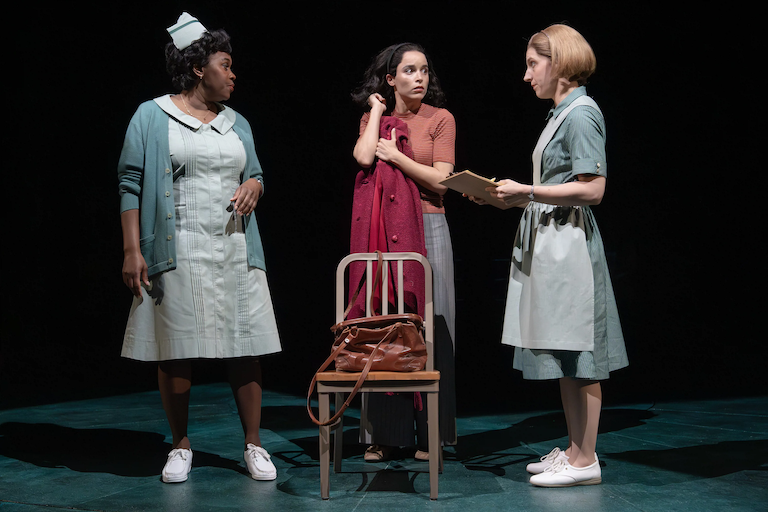
What follows is Mann’s hauntingly hypnotic opening number, “You Fall,” in which Susanna explains the “universe’s delicate skin” which separates life in the outside world from the snare of a mental institution. The way the actress progressively opens up vocally hints at the change to come, as by song’s end Susanna “falls” twenty years into the past, back to her “first few moments” at McLean. The juxtaposition is immediate and stark without ever once feeling jarring, as Canfield moves from the tight, controlled disposition of her mature self to the disoriented, fidgeting eighteen-year-old girl whose few earthly possessions get stripped from her for fear that anything and everything could become a weapon for self-harm.
Though this temporal switching recurs throughout Girl, Interrupted, Canfield must also delve further back in time, to the turning points of Susanna’s adolescence. In an individual counseling session, Dr. Wick (Emily Skinner) probes her to speak about her illicit relationship with her high school English teacher. We witness Susanna slip into a reverie in real time, as animated by Canfield’s face and particularly in her eyes, our portal to the past and the profound influence of memory. Mann has crafted an ethereal, jaunty song, “At The Frick Museum,” and it is a marvel to watch Canfield wrenched back in time with the melody and forward again by Dr. Wick’s interruptions.
The apex of Canfield’s exemplary performance comes at Susanna’s most vulnerable moments. Against the backdrop of America’s political unrest in the late 1960s — “War in Vietnam. Assassinations. Riots. Protests. Shootouts.” — Susanna suffers a “feral” dissociative episode, violently biting her hand open because she’s unable to see the bones underneath her skin. To witness our usually unflappable narrator come undone so significantly is unsettling, especially given how Canfield plays the scene with emotional abandon.
Even more devastating is a scene that follows, when Susanna awakens from a sedative and sobs uncontrollably that she has “lost some time.” Canfield makes Susanna’s grief vastly empathetic, and the moment serves as necessary catharsis for the audience as well, as they witness Susanna process this trauma. The fact that in between these two potent scenes, Majok cleverly has Susanna fall back in time again to the Frick Museum, to the moment she and her teacher see the Vermeer, demonstrates the actress’ impressive dexterity.
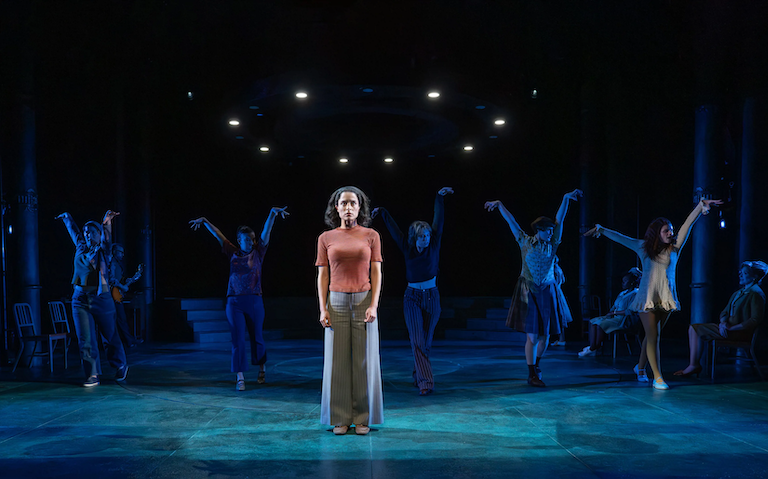
For a show of such painful truths, Girl, Interrupted ends on a note of satisfying recognition through Mann’s mellifluous “I See You” and director Jo Bonney’s simple, elegant staging of the ensemble in a staggered line progressively approaching the audience. Majok’s stage directions indicate that by the play’s conclusion, Susanna sees herself as “grand and undeniable.” So, too, is Canfield’s performance.