
The Post-Show Read
Anne Washburn’s ‘Anon’ Is Ambitious and Chilling but Chilly
David Buchanan
Nota bene: This article contains detailed descriptions of scenes from Anon.
“Because it’s an outrageous fiction, people in this play are interacting constantly with screens,” reads one of Anne Washburn’s prefatory notes in her script for Anon, her world premiere play about the strangulating conspiracy theories that cropped up across the nation in advance of the 2024 presidential election.
No doubt written facetiously, this line introducing the text of the production, which opened off-Broadway at MCC Theater on October 14, accentuates the most terrifying facet of the play, beyond, of course, the deranged, disprovable hypotheses that the main character, Jeanie (an outrageously captivating Crystal Finn) espouses; namely, our inescapable obsession with devices and the downward eddy into which they’re pulling society. Even more devastating is Will’s (Jeremy Shamos) assertion to his husband, Adam (Jeff Biehl), that, because of the internet, “[n]o one needs the real world” anymore.
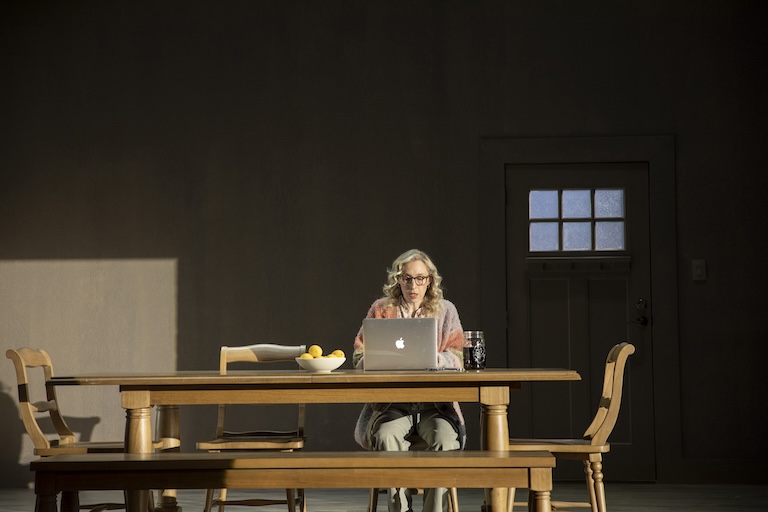
The play begins simply enough with Jeanie, a mother of two living with her husband in suburban San Antonio, Texas, typing at her dining room table; however, she’s accompanied by ominously grandiose orchestral music. When her daughter Delia (Izabel Mar) dashes past her in a fury, ignoring her mother’s half-hearted greetings, Jeanie resorts to texting her to suss out what’s wrong. The image of a character, whether Jeanie, Will, or Adam, hunched over and attentively or vacuously peering into the blinding glare of a MacBook Pro or their iPhones recurs throughout the production, and having this addition reflected back to the audience in a theatre rather than via a television or cinema screen is somehow incredibly jarring.*
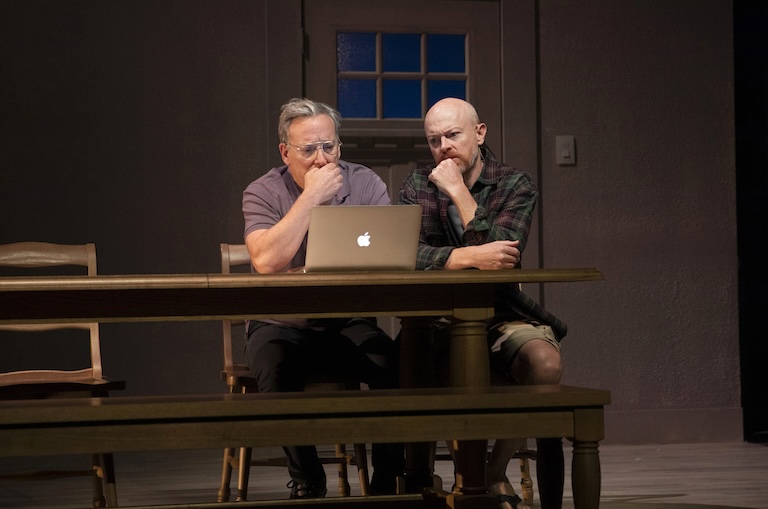
The coldness between mother and daughter in the opening moments of the play soon reveal what lies at the heart of Anon: Jeanie fashions herself a conservative influencer who has been “shadowbanned” on Twitter and tries to rebuild her audience on other platforms, most notably TikTok. Jeanie’s new next door neighbors Will and Adam are lured into her orbit, at first unwittingly and then with fervor, when Adam sleuths his way to her TikTok account and sees a video of her decrying their pride flag, which the husbands received as a housewarming gift. Although this flag is the heart of the conflict, Anon does not unspool the way the audience expects.
Structurally, Anon is an ambitious work that stages dueling family dramas while interpolating both multimedia content and multiple Shakespearean soliloquies, the latter introduced through Delia’s high school English assignment. Tony Award nominee Anne Kauffman directs Anon simply and competently—recall the heartbreaking austerity of her Mary Jane on Broadway with Rachel McAdams—but she has moments of stylistic flourish, too. As Jeanie listens to a conspiracy theorist’s podcast, for example, Kauffman and her design team render the audio with rich sound design by Tei Blow and accompanying visually-striking lighting by Cha See, likely signaling the dangerous allure of such thinking. But much like the mighty storm that Jeanie repeatedly foretells, Anon’s ideas and content overspill its tight, two-hour frame. The play is impressive and chilling, but also a bit chilly.
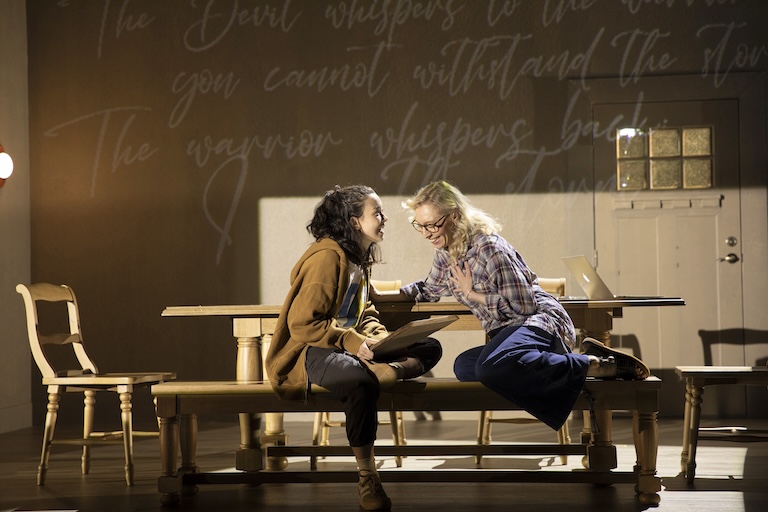
As Jeanie, Finn accomplishing the near-impossible task of making her character immediately identifiable and everyday before she descends into full King Lear-ean madness by the play’s end. Most impressive is how Finn marks this gradual devolution through Jeanie’s physicality. In the opening scene, she hints at Jeanie’s brewing rage when Delia texts her in disbelief that her mother would actually want talk to her rather than with “a bunch of strangers on the internet,” and Finn’s hands tremble uncontrollably, an outward manifestation of her seething anger at not being taken seriously. Scenes later, Jeanie untethers further from reality when she enters “laughing half hysterically half joyously”—I’d say entirely manically—when she believes that Elon Musk has followed her social account, until she has “a pretty inward ragged response” when she realizes it was only “a parody account.” To watch Finn play this scene is akin to seeing a human balloon deflate in real time.
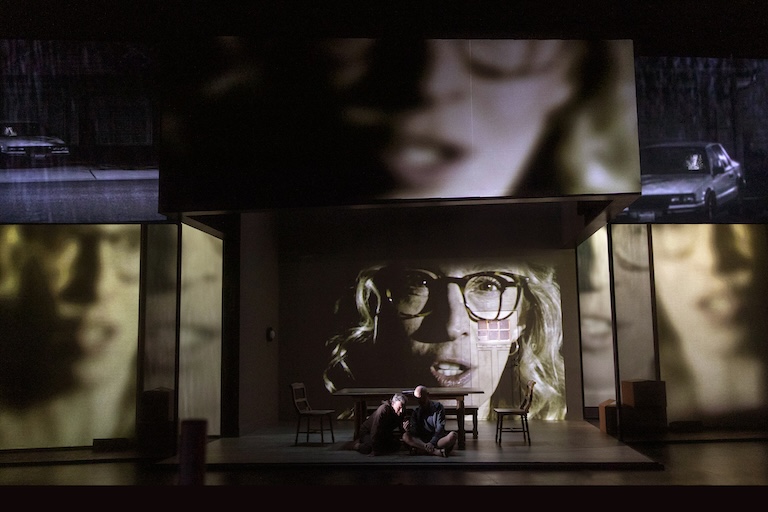
In its most provocative moment, Anon moves to a pre-recorded video at the beginning of Act II in which Jeanie appears with her family on a talk show opposite the Vice President of the United States—I won’t spoil who—to be feted as a “digital warrior.” This scene is Anon at its funniest and Finn at her most clown-like, all bulging eyes and twirling tongue, but the humor belies a real fear that this alternate reality is not terribly unfathomable. The segment is shortly revealed to be the stay-at-home mom’s daydream. And while Finn’s flashiest moment might be the play’s final minutes, I think her best moment comes earlier, when she violently pulls Delia toward her while declaring, “I. Never. Lie.,” after Delia confronts her about an incorrect and horrifying post. It seems to me that this is where her last tether to reality snaps.
But as much as Finn’s undeniable performance steals the show, the most significant character arc belongs to Jeremy Shamos’ Will. When we first meet Will, he enters with a certain weariness from work but joy from his husband and new home. Once Adam shares Jeanie’s TikTok video about their flag and they continue to obsessively monitor her posts, though, Will descends into paranoia and anger: he buys a Glock, he poses as Musk online to try and bait Jeanie, and he advocates for a lock on their bedroom door.
By far Shamos’ standout scene is his penultimate one, in which Will demands Adam make a video of him exposing what Jeanie has done to them, pretending to brandish his gun, and acting superior that he did not threaten her and her family with “unleashed unkiltered unstoppable fury.” Where he once warned Adam that Jeanie had 312 followers, which constitutes “a mob” that could descend on their house to rip down their flag and do them harm, he now calls upon his own militia, saying, “You know what to do, Internet.” The Tony-nominated actor plays the scene with the exact right amount of indignation and gusto. Most importantly, Washburn seems to showcase how someone may lose one’s own sanity by paying attention to and rallying against online cranks.
Through its use of soliloquy and its direct references to King Lear, Anon suggests that our social present is Shakespeareanly tragic. Washburn’s play is an admirable attempt to wrangle our sociocultural insanity into the shape of a two-hour drama, even if the play is ultimately not as electrifying or galvanizing as one might expect given its topic. Indeed, immediately following my press performance on an appropriately stormy day, no less, I felt not shocked or thrilled, but instead overwhelmingly sad, despite Washburn’s satirical, often humorous bent. The lingering power of the production is not that Jeanie is an “outrageous fiction,” but rather that she’s frighteningly recognizable, which makes for a very sobering experience.
* Ironically, this is the second consecutive production at MCC Theater that interrogates the effect of the proliferation of devices on how we communicate, following Birthright over the summer; that show’s third act featured a tremendous sequence in which arguing characters repeatedly interrupt themselves to Google search better information to win their debate, while the sound of all conversation on stage gets muffled when a character pulls out their phone to read a text.
Follow The Windowcard on Facebook, Twitter, Bluesky, and Instagram for more in-depth articles and interviews.