
In Birthright, Molly Bernard Makes a Compelling, Complicated Dissenter
David Buchanan
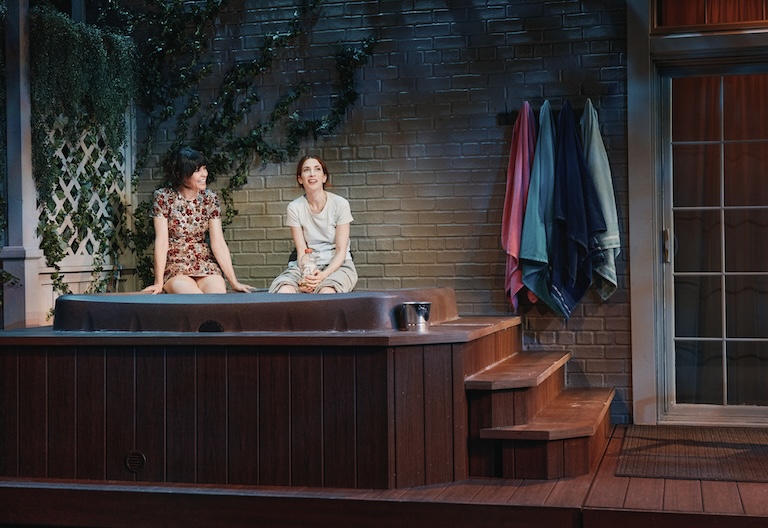
Nota bene: This article contains detailed descriptions of scenes from Birthright.
From the first scene of Jonathan Spector’s sprawling new play Birthright, a three act, nearly two-decade spanning saga currently playing at MCC Theater, the audience may intuit that Molly Bernard’s character Izzy will not have quite the same trajectory as the others in the ensemble drama.
Yes, Izzy and Chaya (an excellent Zoë Winters) have been best friends since pre-school—they’re 22 when the play begins—and yes, they’ve just shared an experience with four new friends on the title Birthright trip to Israel. The play’s opening moments between the two characters are delightfully gossipy and catty, a register at which Winters particularly excels.
But the roots of Izzy’s discontent, at least in comparison to her five peers, are evident from the beginning and only magnify with the passing of the intervening 18 years. In the first act, Chaya summons Izzy and their new Birthright friends to her parents’ house in the suburbs of D.C. for a reunion only three weeks after their return from Israel. Chaya also corrals the group to keep Alona (Molly Ranson) from hastily making Aliyah, moving to Israel, surmising that she’s made the decision only because she’s smitten with a man she met. In their conversation with Alona, Izzy characterizes the Birthright experience as “seductive / but also like / I’m not sure if we were really seeing what it would actually be like” to live there.

Although Izzy would never consider moving to Israel herself, she has similarly been emotionally struck by someone on Birthright, Lev (Hale Appleman). In the play’s first great scene, the two sit down alone for the first time since Lev surreptitiously escaped the trip for weeks of self-guided wanderings around the Middle East. During those weeks, Izzy has written him “like fifty emails,” which to her dismay Lev has printed out and annotated. It is a beautiful scene of youthful bashfulness, desire, and curiosity that Bernard handles most deftly.
In his attempt to explain why he quit Birthright early without a whisper of a warning to his new friends, Lev characterizes the trip as inauthentic, like “Styrofoam,” and Izzy asks in response with full sincerity, “I was Styrofoam?” In this moment — as in her Broadway debut in 2024 in Leslye Headland’s Cult of Love — Bernard exhibits an ability to pull the audience ever-so-gently forward into her emotional state and quiet them into pin-drop silence, attending to her every word.

If the first act feels akin to entertaining, comfortable table-setting, then the second act begins to heighten the tension that Spector must have known audiences would anticipate as the play’s timeline lurches forward to the present, pausing in the month of October 2016.
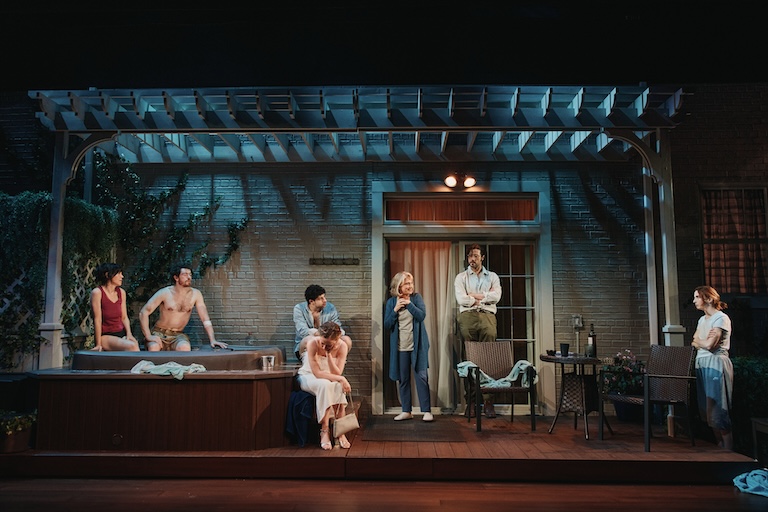
Against the backdrop of Hillary Clinton’s anticipated “electoral college blowout,” the six friends reunite again the evening before Alona’s wedding and impending move to Israel. Their contentious discussion begins because Alona’s husband’s uncle is, in Izzy’s words, “Netanyahu’s right-hand man” who delivered a “sociopathic” toast at the rehearsal dinner. Izzy feels strongly that their group toast at the wedding the next day must make clear that Alona should not be “morally implicated” in the country’s actions, especially because “Israel is on the edge / of a point of no return.” In the ten years since their trip, Izzy’s impression of Birthright has evolved from “seductive” to “insanely toxic” and “a rightwing project to indoctrinate the youth.” Yet she maintains, “I don’t hate Israel! / I love it / I love what it aspires to be / what it could be / what it is at it’s best.”
The friends’ argument, gathered around Chaya’s parent’s hot tub in the middle of the night, is Birthright’s first heavy, significant political debate. But as Sara Holdren wrote in her review of the play for New York Magazine, “This is writing as character, not as megaphone,” and indeed, what is rewarding about Spector’s play is not how it succinctly rehashes decades-long debates about the Middle East, but rather how those debates possibly reflect and refract upon the lives of his characters of whom we are growing fond in real time.
Take, for example, a short vignette earlier in the act in which Chaya and Izzy, those friends since pre-school who have now worked for the Obama administration and J Street advocacy group, respectively, chat alone, and Izzy reveals that she was pregnant seven months ago but had a miscarriage. In response, Chaya suggests to her that she would have supported her at the time if she knew, and Izzy simply replies, “I left you a couple voicemails.” Bernard is simply moving in this scene, embodying Izzy’s detachment from and deep sadness about her miscarriage while also registering the hopeless resignation that her friend (now loosely defined as such) will never offer her the emotional support she needs.
It is amidst this deepening discord between Izzy and the group that Spector, in between the second and third acts, lunges us forward to October 7, 2023. In the aftermath of the attack and the friends’ WhatsApp discussion about the “Fog of War” in the ensuing weeks, Izzy decides to leave the group chat, a decision that is compellingly displayed via projection dead center stage. In The New Yorker, Emily Nussbaum admits, “The moment made me gulp. I’ve seen similar splits occur in my own circles, and it was exciting and disturbing to imagine these conflicts made visceral onstage.”

Spector delivers on those long-gestating pyrotechnics in the third act, during which most of the characters have reunited again at Chaya’s family house after a shocking death amongst their friend group. Returning home from Shiva, questions about how their late friend processed October 7 and its aftermath devolve into a fiery, spiraling debate about ceasefire, settler colonialism, genocide, the partition plan, unconscious bias against Jews, and Zionism. Bernard and Winters bring their quarrel to furious and unexpectedly furiously funny heights as both characters rapidly grasp for their phones to reference articles in support of their arguments as their words trip and tumble out of their mouths. Eli Gelb, a Tony Award nominee for Stereophonic, offers a great, humorous assist as Noah futilely attempts to diffuse the combustible situation.
As Nussbaum suggested, it is pulse-pounding to see these contemporaneous debates unfold on stage, especially given how vociferously both Bernard and Winters tear into the material. But Birthright concludes on a somber and communal note as Spector (momentarily) resolves this conflict between characters not with a single political concession, but rather on personal terms between Chaya and Izzy. In some sense, the play couldn’t end any other way. As Helen Shaw recently noted on The New York Times’ Cannonball podcast, “I find one of the pleasures of the theatergoing experience – or any art – is that I don’t have all the answers,” joking that a play should not “answer feminism in just an hour and a half, no intermission.”
Beyond the tightrope that this ensemble of actors, especially Bernard and her contrarian Izzy, must navigate, one particularly harrowing line from the third act seems to transcend the stage. During Izzy and Chaya’s confrontation, Alona says to them both, “[W]hatever you all think you’re doing here… it’s not getting anyone there any closer to any actual real fucking solution.” This is not a sentiment I suspect Spector holds, nor is it one I suspect his characters believe, either. Yet it is the predominating sentence from the production that continues to reverberate in my mind, and it’s one the characters, at least fleetingly, take to heart, as they put their ideological and existential issues aside to mourn a friend and share a meal. It is, appropriately and perhaps inescapably, a simultaneously moving and intentionally, frustratingly unrevolutionary conclusion.