
In ‘A Woman Among Women,’ Julia May Jonas Grapples with History
David Buchanan
Nota bene: This article contains detailed descriptions of scenes from A Woman Among Women, including the production’s final moments.
In the author’s note to A Woman Among Women, Julia May Jonas explains her play’s indebtedness to Arthur Miller’s All My Sons, beginning with the original stage directions from which her new drama initially grew and referencing the myriad other “connections” that “weave their ways throughout” the piece.
These resonances are well-wrought, from the hidden moral fallibility of both play’s central characters, to the illicit romantic relationships that form between characters who are connected by absent siblings, to playful references to the houses’ basements as either a jailhouse or laboratory to entertain the neighborhood children. But Jonas never hews too closely to Miller’s work.
As the playwright notes, the two domestic dramas’ primary connection is their “intractable situations and dilemmas.” Indeed, A Woman Among Women works best when Jonas focuses on unspooling the yarn of the central mystery of the play, namely, what were the exact circumstances surrounding her unseen character Jo’s twenty-year prison sentence, which caused her to leave behind a husband and young daughter.
In Jo’s absence, A Woman Among Women centers on her mother, Cleo, the founder of a woman’s “psychological wellness center” and a purportedly upstanding citizen; she thus serves as a direct analog to Arthur Miller’s Joe Keller. The play’s forward momentum begins with the arrival of Jo’s husband Roy (Gabriel Brown), which coincides with her neighbors’ attempts to file an appeal of Jo’s conviction.
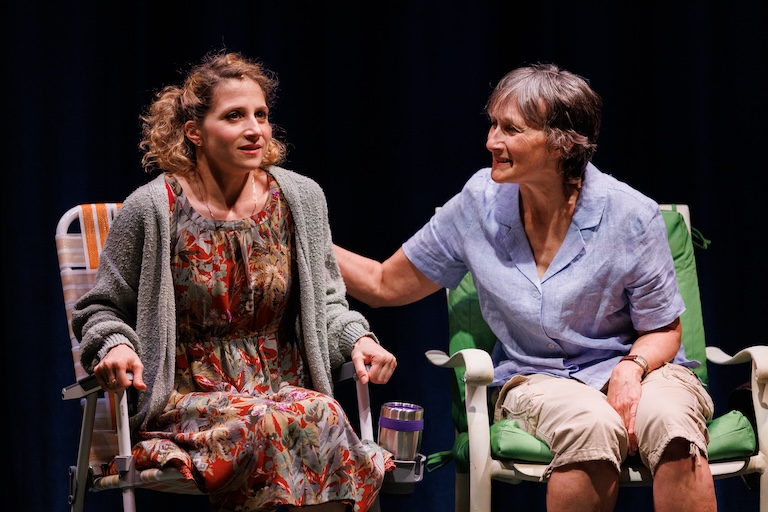
Just as engaging as watching how A Woman Among Women creates parallel circumstances to All My Sons with an importantly matrilineal bent is seeing how the play grapples with its own (fictional) history, creating layers within the plot to excavate the deeper lineage of the characters’ community.
One of the production’s most thought-provoking moments initially feels like a non-sequitur: Cleo interrupts a rote conversation between her platonic life partner Tina (Tina Chilip) and Roy with a macabre tale about their neighborhood from centuries earlier. As she relates, three houses with three families from the Johannesberg family tree lived on the same road. But after missing several seasons in their farming community, folks found all the Johannesbergs dead in their homes, discovered as “rotting corpses.” The street now bears the moniker “Shades of Death Road,” and Cleo observes that “we’re always dancing on the bones of the dead.”
This is one of Jonas’ most evocative lines in the script, which also carries with it a metatheatrical nod to how she builds upon the legacy of Miller and his antecedents. The interlude is also striking because of its form and its staging, as Cleo conveys this information through song — in keeping with “the Greek tragic form as laid out by Aristotle” — as the rest of the ensemble of contemporary characters quickly don pioneer-period dress and all drop dead on the stage floor.
For such a grim tale and an introspective moment for her character, the shrewd Dee Pelletier plays Cleo if not gleeful, then at least with a glint in her eye, as if to suggest that Cleo relishes in knowing and disseminating this oral history of the community, in which she herself has risen to outsized stature. As cleverly staged by director Sarah Cameron Hughes, Cleo literally centers herself in the narrative, too, standing on top of the tired red beverage cooler that announces itself as the beating heart of Cleo’s backyard and occasionally transforms into a soapbox.
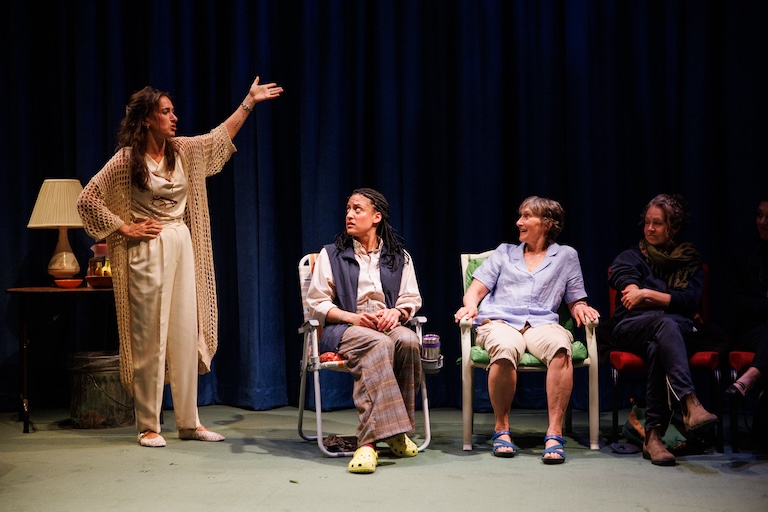
Throughout the early scenes of the play, Jonas carefully signals Cleo’s role as both community leader and especially moral arbiter. On repeated, fleeting occasions, Cleo corrects how other characters speak, deeming a joke about anorexia from her daughter Grace (Zoë Geltman) and another about a pro tennis play from Tina to be “yucky.” Crucially, the audience will likely agree with her assessments, which helps establish the bond between the audience — many of whom are seated directly amongst the performers at Lincoln Center Theater / LCT3’s off-Broadway venue, the Claire Tow Theater — and our flawed matriarch.
Indeed, Pelletier is winsome in these early scenes of the play, especially as Cleo affably but unassumingly welcomes the audience into her backyard and introduces us to each of the many characters that flit in and out of the space and the plot.
But as in many an American tragedy modeled after the Greeks, this gregarious nature masks a smoldering secret. A Woman Among Women interrogates what happens when narratives and authority like Cleo’s begin to erode, in this case worn down by inquisitive and inexhaustible neighbors and friends.
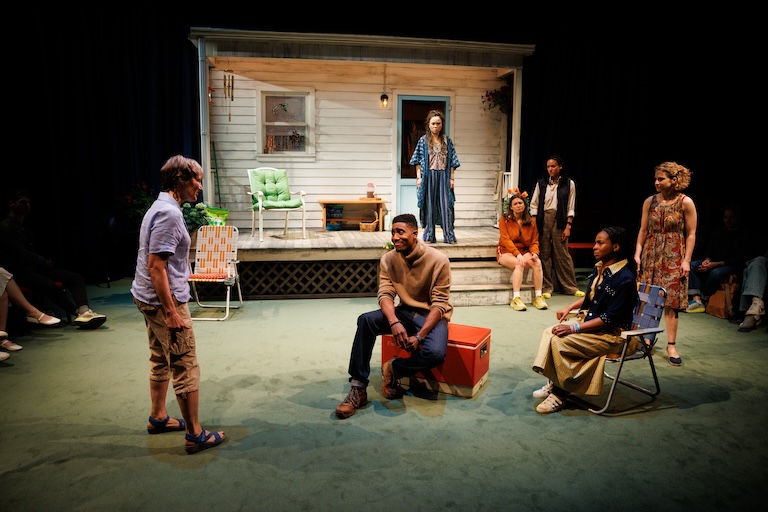
The play rapidly gains momentum in its final scene, when the free-flowing communal circle of cast members and audience suddenly becomes more rigid as Jonas and Hughes have Cleo’s porch arrive onstage. As the ensemble wrests pivotal information out of a defiant Cleo and their questions mount, that red cooler retakes the spotlight again, this time as the figurative gallows, as Cleo climbs atop to demands of the others, “Be the Furies. Put me on trial.”
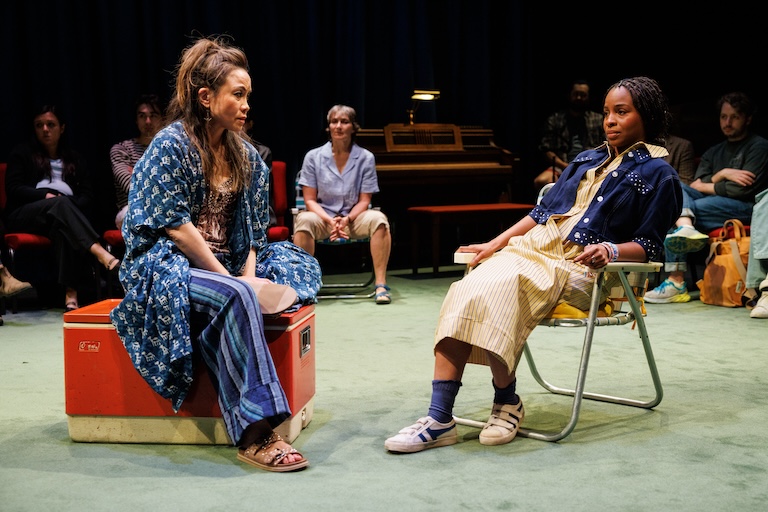
Audience members familiar with All My Sons will also likely see the porch and screen door and immediately anticipate what will happen to Cleo, remembering full well the manner in which Joe Keller goes inside his house to end his life. Jonas wisely subverts these potential expectations, opting instead for a non-violent conclusion to A Woman Among Women which may lack the raw shock and propulsiveness of Miller’s play, but which chooses a meaningfully different end.
In its pivotal climactic scene, when all nine other characters have left Cleo’s side, the play calls for the ensemble to return to the stage, portray the Johannesberg clan again, and dance exuberantly as Cleo implacably and inscrutably stares on “alone.” In these final moments, Jonas and Hughes excitingly collapse the distant past and the immediate present, highlighting the consequences of a community averting its gaze, either by choice with or through neglect with the Johannesbergs. In A Woman Among Women as a whole, Jonas similarly wrestles the histories of genre and those of her own creative making.